Introduction:
In a world that is more connected than ever, children are growing up in an environment shaped by global interactions—where economies overlap, cultures meet, and digital platforms enable collaboration across continents. At Banyan Tree School Chandigarh, recognized among the Best Play Schools in Chandigarh, understand that this transformation has redefined the purpose of education. Rather than relying solely on memorisation, modern learning now emphasizes skills, values, and global perspectives that help children grow into confident, empathetic, and internationally aware individuals.
Early-years programs across the country increasingly acknowledge the importance of global teaching standards. Families exploring play schools often seek more than conventional learning methods—they look for global exposure, innovative pedagogy, and holistic developmental experiences that prepare children for a rapidly changing world. The focus has shifted from traditional classroom routines to a globally oriented educational approach that nurtures curiosity, adaptability, inclusion, and cultural understanding.
This shift is not merely a trend—it marks a vital evolution in early education. Here’s why cultivating a global mindset and embracing international-standard pedagogy is essential for shaping the next generation of young learners.
About Us:
We believe in fostering global citizens from early years, blending world-class pedagogical standards with a nurturing community environment. Our curriculum combines thematic learning, multicultural celebrations, language exposure, creative arts, collaborative projects, and international-style teaching techniques. Through extracurricular offerings like world-culture clubs, global literature storytelling sessions, international art and music, and multicultural events — children regularly experience diversity, empathy, and global awareness. Events such as international festivals, global art weeks, cultural exchange fairs, and collaborative projects help learners connect beyond borders. With trained educators and globally inspired pedagogy, we equip children to become open-minded, culturally sensitive, creative, and adaptive — ready to embrace a world without boundaries with confidence, curiosity, and compassion.
1. Understanding the Need for a Global Mindset in Early Childhood
A global mindset refers to the ability to understand, appreciate, and engage with cultural, social, and intellectual diversity. When children develop this perspective early, they benefit in multiple ways:
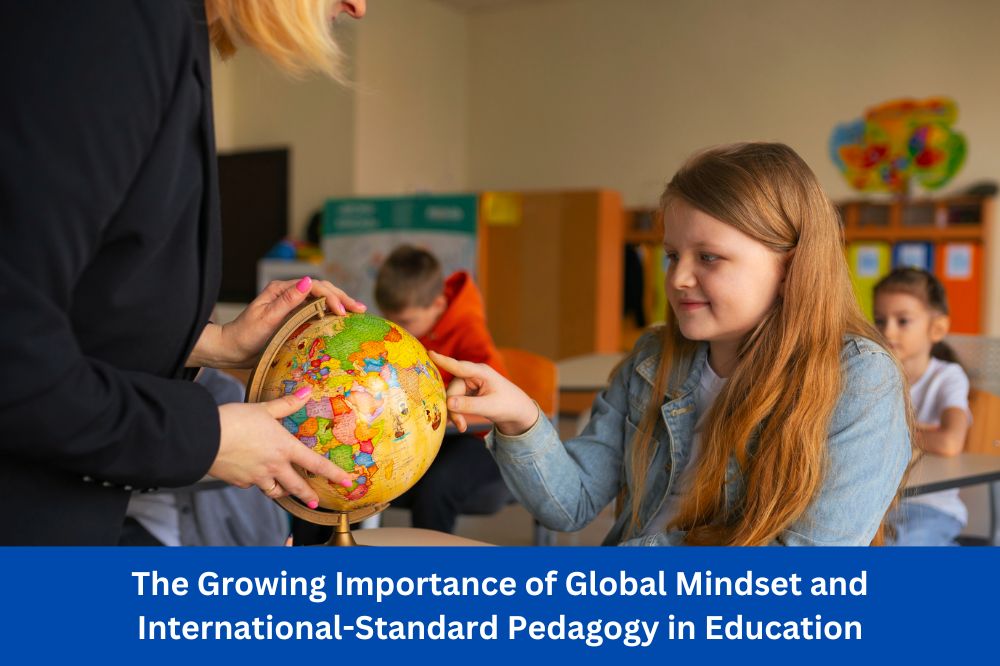
1.1 Builds Cultural Awareness and Inclusivity : Young children naturally show curiosity about the world. When educators introduce stories, traditions, and celebrations from different cultures, it expands their worldview. Exposure to different languages, foods, festivals, and customs helps them understand that the world is diverse—and that diversity is a strength.
1.2 Encourages Open-Minded Thinking : A global mindset removes rigid thinking patterns and encourages children to observe things from multiple perspectives. They develop empathy, flexibility, and respect for differences—qualities that are essential for building harmonious communities in the future.
1.3 Strengthens Cognitive and Social Skills : Interacting with multi-cultural content stimulates creative thinking. Children ask more questions, compare patterns, and make thoughtful connections between ideas. These early cognitive skills form a strong foundation for academic learning throughout school.
1.4 Fosters Adaptability for Future Work Environments : The future workforce will be global, whether physically or digitally. Children exposed to diverse learning experiences from a young age are better prepared to handle collaborations, communication, and problem-solving in multicultural environments.
2. What Makes International-Standard Pedagogy Different?
Education systems around the world, especially in progressive countries, focus on active learning, skill-based development, and inquiry-driven exploration. International-benchmark teaching incorporates:
2.1 Play-Based Learning : This is one of the most effective and scientifically proven methods for children under eight. Play-based environments encourage children to experiment, explore, create, and imagine. They learn through real-world experiences, hands-on activities, and collaborative interactions.
2.2 Multisensory Instruction : International models emphasise engaging the five senses—touch, sound, sight, movement, and smell—to deepen understanding. This approach strengthens neurological development, enhances retention, and builds strong conceptual clarity.
2.3 Project and Inquiry-Based Learning : Instead of simply giving answers, teachers encourage children to ask questions, investigate concepts, and find solutions on their own. This nurtures independence, curiosity, and problem-solving skills.
2.4 Holistic Competency Development : Modern pedagogy includes emotional intelligence, communication, creativity, social manners, leadership, and digital awareness—skills that are crucial for real-world success.
2.5 Continuous Observation and Assessment : Instead of traditional examinations, children are assessed based on daily interactions, activities, and skill development. This reduces pressure and gives a real picture of each child’s growth.
3. Why Early Childhood Is the Ideal Stage to Introduce a Global Approach
A child’s brain forms more than one million neural connections per second in the early years. This development stage is the most receptive period for new learning, making it the perfect time to introduce global concepts.
3.1 Language Development Is Rapid : Children can absorb multiple languages with ease during early childhood. Exposure to foreign vocabulary, songs, and phrases enhances listening and communication abilities.
3.2 Early Values Become Lifelong Habits : Respect, empathy, collaboration, honesty, and inclusiveness—values introduced early stay with the child forever. A global curriculum strengthens character development through diverse stories, ethics, and cultural experiences.
3.3 Social Behaviour Is Forming : A global environment teaches children how to interact politely, share, cooperate, and build friendships with peers from different backgrounds.
3.4 Curiosity Is at Its Peak : This is the age when children ask the most questions. International pedagogy nourishes this curiosity instead of suppressing it, helping children become lifelong learners.
4. How Global Mindset Education Shapes Real Learning Outcomes
Parents seeking play schools often look for institutions that do more than basic teaching. Global-minded systems have proven benefits:
4.1 Improved Academic Skills : Children perform better in reading, mathematics, reasoning, and language skills because global pedagogy strengthens conceptual understanding instead of rote memorisation.
4.2 Enhanced Creativity and Innovation : Exposure to global art forms, stories, and learning styles sparks imagination. Children learn to think outside the box and bring fresh ideas to their work.
4.3 Strong Emotional Resilience : Classrooms that celebrate diversity teach children how to deal with emotions confidently and respectfully. They learn empathy, patience, and problem-solving in social situations.
4.4 Better Communication Skills : Whether through storytelling, role-play, cultural exchange activities, or stage exposure, children learn to express themselves clearly and confidently from an early age.
4.5 Future-Ready Competencies : The world is moving toward AI, digital tech, and global collaboration. International teaching formats introduce foundational digital awareness, adaptability, and collaborative skills early.
5. Key Elements of a Global and International-Standard Classroom
5.1 Thematic and Integrated Curriculum : Lessons are connected through themes like seasons, cultures, science, festivals, or world communities. Children understand concepts in a meaningful, real-world context.
5.2 Global Festivals and Cultural Celebrations : Inclusive celebrations teach children about different cultures while promoting respect and unity.
5.3 Interaction with Global Resources : Digital tools, videos, stories, and global learning platforms help children explore new knowledge beyond local boundaries.
5.4 Modern Learning Spaces : Child-friendly classrooms designed with learning corners, art stations, sensory zones, reading corners, and collaborative spaces make learning engaging and encouraging.
5.5 Professional Teacher Training : Educators trained in international methodologies create classrooms where children feel safe, valued, and inspired to learn.
6. Role of Parents in Supporting Global Awareness at Home
The home environment plays a huge role in reinforcing what children learn at school. Parents can:
- Introduce books from various countries
- Explore foods from different cultures
- Watch global stories and animated shows
- Encourage children to interact with peers of diverse backgrounds
- Talk about festivals, traditions, and values from around the world
When both teachers and families work together, children grow into globally aware, emotionally mature young learners.
7. How Early Exposure to Global Education Helps Later School Years
The impact of global mindset and international teaching is not limited to preschool. It influences the entire academic journey:
7.1 Smooth Transition to Primary School : Children who have learned through active, hands-on methods adapt quickly to primary-level academics.
7.2 Strong Participation in Class : They are confident speakers, curious thinkers, and expressive communicators—attributes that help them perform well across subjects.
7.3 Leadership and Collaboration Skills : Early experiences in group projects, stage events, and creative activities foster leadership potential.
7.4 Better Understanding of Diverse Subjects : Global exposure strengthens learning in geography, history, literature, languages, and even science.
8. Creating Responsible Global Citizens
Ultimately, the purpose of international-standard education is to shape individuals who:
- Think critically
- Solve problems with creativity
- Respect others
- Value global unity
- Participate meaningfully in society
Children nurtured in global environments become adults who contribute positively to the world.
9. How Institutions Deliver Global Mindset Education
The growing demand for play schools is driven by parents who prioritise global teaching. A high-quality institution integrates:
- Experiential activities
- International-style curriculum
- Cultural immersion
- Skill-building programs
- Modern teaching aids
- Globally trained educators
- Personality development modules
- Social-emotional learning frameworks
Classrooms are designed to help children explore freely, communicate confidently, and learn holistically.
Extracurricular programs—like dance, music, yoga, theatre, sports, art, reading clubs, and science labs—add further global exposure by helping children experience creativity and leadership through multiple mediums.
Regular events such as cultural days, world-awareness weeks, international art exhibitions, family festivals, field trips, and storytelling carnivals offer real-life global learning experiences.
Conclusion:
The world is evolving faster than ever. To keep pace, children must develop a broad, global outlook and a deep sense of empathy, adaptability, and curiosity. International-standard pedagogy in early education lays the foundation for such holistic development. It helps children grow not only academically but also emotionally, socially, and intellectually.
For parents searching for play schools, choosing an institute that embraces global teaching and international pedagogy ensures that their child is empowered with future-ready skills from day one. The goal is not just education—it is transformation. It is preparing children to thrive in a world where collaboration, creativity, respect, and global awareness define true success.
FAQs:
Q. 1 What does a global mindset mean in education?
Ans : It refers to helping children understand diverse cultures, perspectives, and global responsibilities.
Q. 2 How does international-standard pedagogy benefit students?
Ans : It introduces modern, research-backed teaching methods that encourage curiosity and critical thinking.
Q. 3 Why is global exposure important for young learners?
Ans : It prepares them to thrive in a highly connected and multicultural world.
Q. 4 How do schools build global awareness in daily learning?
Ans : Through projects, global themes, cultural celebrations, and collaborative learning.
Q. 5 Does a global mindset help with communication skills?
Ans : Yes, it encourages open-minded dialogue, empathy, and confidence in expression.
Q. 6 Can global pedagogy improve academic performance?
Ans : Absolutely—modern teaching helps children grasp concepts faster and apply them meaningfully.